
Weight Loss Body Composition: Balancing Fat Loss and Muscle Gains
Why the Scale Lies — and What to Track Instead
Weight loss body composition is the real story behind the number on your scale — and for most people, it’s a far more honest picture of their health.
Here’s a quick answer to what it actually means:
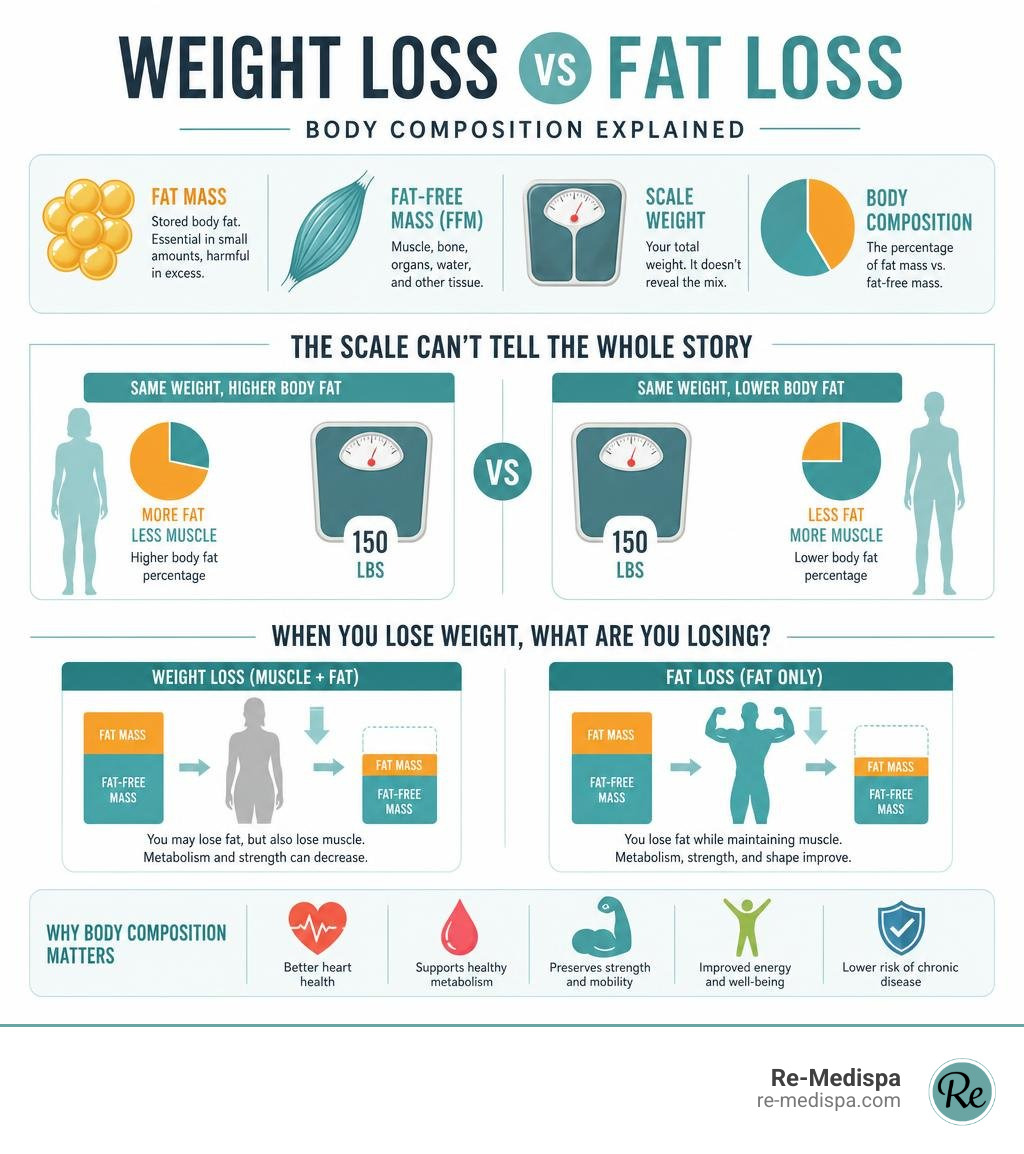
Body composition breaks your total weight into two categories:
- Fat mass — stored body fat
- Fat-free mass (FFM) — muscle, bone, organs, and water
When you lose weight, the quality of that loss matters just as much as the amount. Dropping 10 pounds of pure fat is very different from losing 7 pounds of fat and 3 pounds of muscle.
Two people can weigh exactly the same and look — and feel — completely different, simply because their body composition differs.
That difference has real health stakes. Excess body fat, especially fat stored deep in the abdomen (called visceral fat), is linked to heart disease, type 2 diabetes, and metabolic disorders. Muscle mass, on the other hand, supports your metabolism, your energy levels, and your long-term independence.
This guide walks you through everything you need to know: what body composition is, how to improve it, how to measure it accurately, and what the latest research says about doing it safely and effectively.
Why Weight Loss Body Composition Matters More Than Scale Weight
For decades, we have been told to obsess over scale weight and Body Mass Index (BMI). While BMI is a quick screening tool, it fails to distinguish between heavy muscle and heavy fat.
A high-quality focus on weight loss body composition shifts the spotlight to what that weight actually consists of. Carrying excess fat increases your cardiometabolic risk, particularly when it is concentrated as visceral fat around your internal organs.
This regional fat distribution is a major driver of chronic conditions. By optimizing your body composition, you can significantly support cardiovascular disease and diabetes prevention, while preserving bone density for osteoporosis prevention.
Healthy body-fat percentage ranges vary naturally by sex. For women, moderate body-fat ranges typically fall between 23% and 30%. For men, a moderate, healthy range is generally 13% to 20%.
The Science of Weight Loss Body Composition: Fat vs. Muscle
To understand how your body changes, we have to look at fat mass versus fat-free mass (which includes skeletal muscle mass). When people go on restrictive diets without exercising, they often lose a significant amount of muscle.
This is where the “quarter FFM rule” comes into play. Clinical consensus suggests that less than 25% of the total weight you lose should come from fat-free mass for the weight loss to be considered healthy and sustainable.
Skeletal muscle mass is the primary driver of your resting energy expenditure. Your metabolic rate is highly dependent on how much lean tissue you carry; losing muscle directly lowers your daily calorie burn, making long-term weight maintenance incredibly difficult.
The Mechanics of Body Recomposition: Losing Fat and Gaining Muscle
Body recomposition is the holy grail of fitness: losing body fat and gaining muscle mass simultaneously. While traditional fitness lore says you must either “bulk” or “cut,” modern science proves that recomposition is entirely realistic under the right conditions.
This process is highly influenced by your training status, baseline body-fat levels, and sex differences. Beginners or individuals with higher starting body-fat percentages have a much easier time recomposing because their bodies can easily mobilize stored fat to fuel muscle growth.
The rate of weight loss plays a massive role here. While rapid weight loss can produce fast results, gradual weight loss is generally safer for preserving lean tissue.
According to scientific research on weight loss rates and metabolic adaptation, rapid weight loss can lead to greater initial declines in resting energy expenditure. However, the study also noted that improvements in fasting glucose and insulin sensitivity after a moderate 6% to 11% weight loss were actually greater with a rapid protocol, though these differences leveled out at deeper weight loss percentages.
How to Optimize Your Weight Loss Body Composition Through Nutrition
If you want to protect your muscles while losing fat, your diet needs two things: a controlled energy deficit and adequate protein intake.
Protein provides the essential building blocks for muscle protein synthesis, signaling your body to preserve fat-free mass even when calories are low. But how much do you actually need?
A landmark 10-week study published in the scientific research on nutritional protocols for body recomposition compared resistance-trained athletes on a high-protein diet (2.5 g/kg of body weight daily). The group that maintained a modest 250-calorie deficit while eating this high-protein target successfully achieved significant body recomposition, losing substantial fat mass while simultaneously building lean muscle.
At Re-Medispa, we build personalized dietary and clinical strategies to help you navigate these nutritional targets safely. You can learn more about our comprehensive clinical support on our Weight Loss Service page.
Exercise Modalities: Resistance Training vs. Aerobic Exercise
To achieve high-quality weight loss body composition changes, the type of exercise you choose matters immensely.
Aerobic exercise (like running or cycling) is excellent for cardiovascular health and increasing daily calorie burn, but it does very little to build or preserve muscle during caloric restriction.
Resistance training (strength training), on the other hand, is the ultimate tool for muscle preservation. By applying progressive overload—gradually increasing the weight or repetitions over time—you send a powerful signal to your body that your muscle tissue is necessary and must be kept.
A comprehensive study published in the scientific research on resistance training for high-quality weight loss demonstrated that resistance training was the only exercise modality that successfully prevented muscle loss and actually increased fat-free mass in both men and women during active caloric restriction.
| Exercise Type | Effect on Fat Mass | Effect on Lean Muscle Mass | Metabolic Impact |
|---|---|---|---|
| Resistance Training | High Reduction | Preserves or Increases | Prevents metabolic slowdown |
| Aerobic Exercise | Moderate Reduction | Minimal effect / potential loss | Temporary calorie burn |
| No Exercise (Diet Only) | Low-to-Moderate | High risk of muscle loss | Decreases resting metabolic rate |
Measuring Progress: How to Track Your Body Composition Changes
If the bathroom scale isn’t the best tool, how should you track your progress? Fortunately, several reliable technologies can help us look inside.
- DXA Scan: Often considered the gold standard, this dual-energy X-ray scan provides a highly accurate breakdown of bone density, fat mass, and lean tissue.
- Bioelectrical Impedance Analysis (BIA): Using safe, low-level electrical currents, BIA measures tissue resistance. Interestingly, combining clinical BIA with a simple waist measurement can be up to 97% as accurate as an MRI for tracking visceral adipose tissue.
- Bod Pod: This utilizes air displacement technology to measure body volume and density, boasting an accuracy rating of +/- 2%.
- Skinfold Calipers: A classic, accessible method. To ensure accuracy, always have the same trained professional perform the measurements.
Outside of clinical machines, tracking your abdominal circumference (waist measurement) is one of the easiest, most practical ways to monitor your central adiposity and ensure you are losing dangerous visceral fat.
Medical Weight Loss and Body Composition: Safety, Side Effects, and Expectations
Modern medical weight loss treatments, such as GLP-1 and GIP receptor agonists (including Semaglutide and Tirzepatide), have revolutionized how we address chronic weight management. However, rapid weight loss from these medications can carry an increased muscle loss risk if not carefully managed.
When patients lose weight rapidly on standard low-calorie diets, a significant portion of that loss can come from lean tissue. To prevent this, specialized nutritional therapies are being utilized alongside medical treatments.
According to scientific research on tirzepatide and ketogenic therapy for preserving fat-free mass, combining Tirzepatide with low-energy ketogenic therapy was significantly more effective at preserving fat-free mass, muscle strength, and resting metabolic rate over 12 weeks compared to combining the medication with a traditional low-calorie diet. Ketosis provides alternative energy substrates (ketone bodies) that help protect muscle tissue from being broken down for fuel.
As with any medical therapy, patient safety is our highest priority. These medications can cause mild, temporary side effects such as nausea, bloating, or fatigue, which typically resolve as your body adjusts. It is vital to undergo these treatments under the close supervision of a licensed clinical professional who can tailor your protocol.
To explore how we support your metabolic health holistically, visit our Wellness Center.
Common Myths About Weight Loss and Muscle Preservation
- The Cardio Myth: Many believe that hours of steady-state cardio is the only way to burn fat. In reality, excessive cardio without resistance training can cause your body to burn through muscle tissue for energy.
- Starvation Mode: While severe caloric restriction does cause metabolic adaptation, your metabolism doesn’t permanently “shut down.” However, it will slow down significantly if you lose muscle mass.
- Spot Reduction: You cannot choose where you lose fat. Doing endless crunches will not target belly fat specifically; fat loss occurs systemically across the entire body.
- Muscle Turning to Fat: Muscle and fat are two entirely different tissue types. One cannot physically convert into the other. If you stop training, muscle tissue may atrophy, and a lack of activity may lead to fat accumulation, but they never swap identities.
Frequently Asked Questions About Body Composition
Can you lose fat and gain muscle at the same time?
Yes. This process, known as body recomposition, is highly achievable when you combine a structured progressive resistance training routine with a high protein intake and a conservative calorie deficit.
What is a healthy body fat percentage for women and men?
For women, a healthy, moderate body-fat range is 23% to 30%. For men, a moderate range is 13% to 20%. These ranges can shift slightly based on age and individual health factors.
How often should I measure my body composition?
Because muscle growth and fat loss take time, measuring your body composition every 4 to 8 weeks is ideal. Frequent daily or weekly tracking is unnecessary and can be misleading due to temporary fluctuations in water weight.
Personalized Body Composition Support at Re-Medispa
At Re-Medispa, led by our Founder and Medical Director Renata Ciszek, we believe that successful weight management is about so much more than a number on a scale. We provide personalized, honest care designed to help you achieve a healthier, stronger body.
Serving clients across the Northwest suburbs—including Palatine, Schaumburg, Des Plaines, Mount Prospect, and Glenview—we offer advanced medical weight loss options and detailed body composition analysis at our two convenient clinical locations:
- Arlington Heights: 37 S Evergreen Ave, Arlington Heights, IL
- Harwood Heights: 5128 N Harlem Ave, Harwood Heights, IL
We utilize cutting-edge tools, including our AI preview tool for treatment results, to give you a clear, realistic picture of your wellness journey. Ready to take a personalized, medically supervised approach to your health?
To learn more about our comprehensive aesthetic and wellness treatments, explore our medical spa services and schedule your private consultation with us today.