
The Real Difference Between Microneedling and Dermarolling — And Why It Matters for Your Skin
The microneedling vs dermarolling differences come down to one core thing: device design and how precisely needles enter your skin. Here’s the quick version:
| Feature | Dermarolling (At-Home) | Professional Microneedling |
|---|---|---|
| Device type | Manual roller with fixed needles | Motorized pen with adjustable depth |
| Needle entry | Angled (45°), creates micro-tears | Vertical (90°), creates clean channels |
| Depth control | Fixed (typically 0.25–0.5 mm) | Adjustable (0.5–2.5 mm) |
| Sterility | Reusable head — higher infection risk | Single-use, sterile cartridges |
| Collagen stimulation | Mild, surface-level | Deeper, more consistent |
| Best for | Minor texture, product absorption | Acne scars, wrinkles, enlarged pores |
| Setting | At-home | Licensed professional only |
Maybe you’ve seen a dermaroller in a friend’s bathroom cabinet, or spotted one online for $15. It promises the same results as a professional treatment. But here’s the thing — the tool doing the work, how it enters your skin, and who is guiding it all make a significant difference in what actually happens beneath the surface.
Both methods create tiny injuries in the skin to trigger your body’s natural collagen response. That part is the same. But the quality of those injuries — and the control behind them — is where the two approaches diverge in ways that matter for your safety and your results.
Understanding the Microneedling vs Dermarolling Differences
To understand the core microneedling vs dermarolling differences, we have to look at the physics of how these needles interact with your skin barrier.
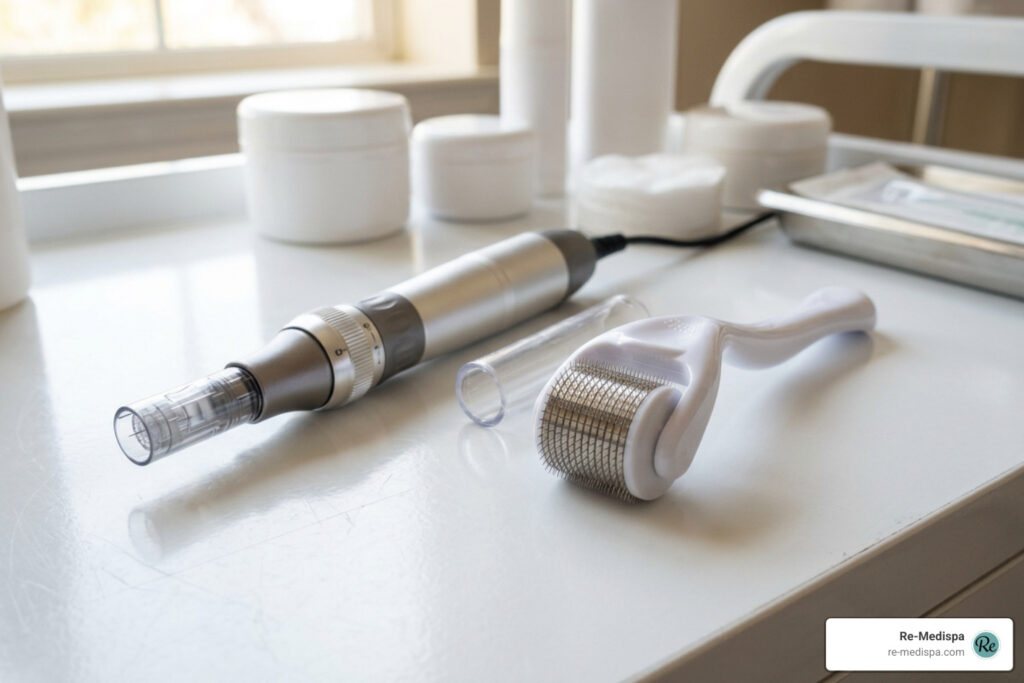
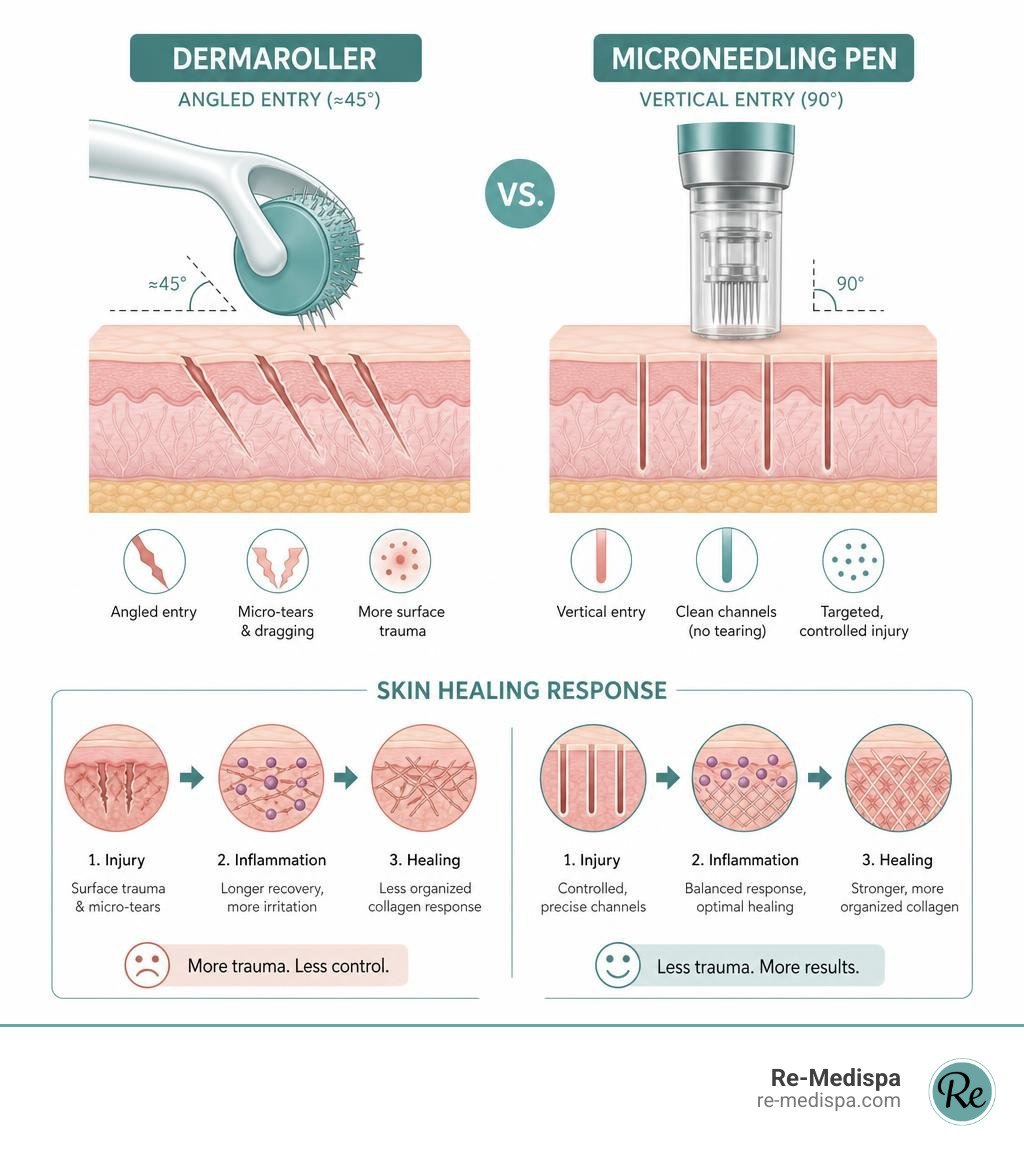
A traditional dermaroller consists of a small drum or barrel studded with fixed metal needles. As you roll this drum across your face, the needles must enter the skin at an angle, rotate while inside the tissue, and exit at an opposite angle. This curved path creates a slicing motion, often referred to as a “ski slope” or “paddle-steamer” effect. Instead of clean punctures, this motion can cause micro-tears in the delicate epidermal layer.
Professional microneedling utilizes an automated, motorized pen-style device. The needle cartridge moves rapidly up and down, stamping the skin vertically at a perfect 90-degree angle. Because the device operates at high speeds—often penetrating the skin up to 100 times per second—the needles enter and exit so quickly that the tissue is displaced rather than torn.
These vertical channels are clean, symmetrical, and close rapidly. This minimizes unnecessary surface trauma while maximizing the depth of the treatment.
Precision, Depth Control, and Treating Delicate Areas
When addressing specific skin concerns, a one-size-fits-all needle length simply does not work. The skin on your face varies dramatically in thickness. Your forehead and the bridge of your nose have very thin skin, while your cheeks are much thicker.
This variability is why professional control is essential. You can learn more about these mechanical nuances in this Scientific comparison of skin needling techniques.
Microneedling vs Dermarolling Differences in Needle Depth
At-home dermarollers are generally limited to very shallow depths, typically between 0.25 mm and 0.5 mm. While this is useful for increasing the absorption of topical hyaluronic acid serums, it does not reach deep enough to trigger true collagen remodeling.
Professional microneedling pens feature customizable depth settings that range from 0.5 mm up to 2.5 mm. This clinical precision allows a licensed provider to adjust the depth in real time as they glide across different areas of your face.
To safely and effectively target deep acne scars or stubborn wrinkles, the needles must reach the deeper dermal layers where fibroblasts reside. This level of deep collagen stimulation cannot be safely achieved with a manual at-home roller.
Microneedling vs Dermarolling Differences in Facial Contour Adaptability
Your face is not a flat surface; it is full of curves, tight corners, and delicate structures. Trying to navigate a wide, rigid dermaroller around the orbital rim (the eye area), the sides of the nose, or the upper lip is difficult and often dangerous.
The small, circular tip of a professional microneedling pen allows for effortless adaptability. Your provider can easily treat hard-to-reach areas with pinpoint accuracy, ensuring even stimulation across all facial contours without risking damage to delicate structures like the eyelids.
Safety, Sterility, and the Risk of Skin Damage
Safety is perhaps the most critical factor when examining the microneedling vs dermarolling differences. Because skin needling punctures your protective skin barrier, any compromise in sterility can lead to serious complications.
At-home dermarollers are designed to be reused, which introduces several risks:
- Needle Blunting: Metal needles dull after a single use. Reusing a roller means you are forcing blunt metal into your skin, which increases pain and causes ragged tears.
- Sanitization Issues: It is virtually impossible to fully sterilize a reusable dermaroller at home. Microscopic skin cells, oils, and bacteria remain trapped at the base of the needles, increasing your risk of infection or breakout.
- Pathogen Spread: Rolling over an active pimple can spread bacteria across your entire face, leading to severe acne flare-ups.
In a clinical setting, safety is built into the protocol. Professional microneedling utilizes single-use, medical-grade, gamma-sterilized needle cartridges that are discarded immediately after your session. There is zero risk of cross-contamination or needle dulling.
The FDA has not authorized at-home dermarollers with longer needles for consumer sale due to these inherent risks, and many cheap, imported rollers are on the FDA’s import alert red list. Understanding these safety guardrails is key to protecting your skin barrier, as outlined in this guide on Understanding the key differences between these collagen-boosting methods.
What to Expect: Results, Downtime, and Side Effects
Because professional microneedling penetrates deeper and more consistently, the skin’s healing response is highly controlled. However, because it is a medical-grade treatment, you should expect some temporary side effects.
Immediately following a professional session, your skin will experience erythema (redness) and mild swelling, resembling a moderate sunburn. This is a normal part of the inflammatory cascade that signals your skin to produce brand-new collagen and elastin.
Most clients find that the redness subsides significantly within 24 to 48 hours. By day three or four, you may experience mild dryness and light skin peeling as cellular turnover accelerates.
Common Post-Treatment Side Effects
- Temporary redness and flushing
- Mild swelling and tightness
- Dryness and superficial flaking
- Minor pinpoint bruising (primarily in areas of deep treatment)
While professional microneedling is safe for all skin types and tones—including darker skin that may be prone to hyperpigmentation from heat-based treatments—it is not suitable for everyone.
You should avoid skin needling if you have active acne breakouts, open wounds, eczema, psoriasis, or if you are pregnant or taking blood thinners. A thorough consultation with a licensed professional is always required to ensure the treatment is safe for your unique skin.
Frequently Asked Questions About Skin Needling
Is professional microneedling painful?
We prioritize your comfort during every treatment. Before your session begins, we apply a medical-grade topical numbing cream to the treatment area for 20 to 30 minutes. Most clients describe the sensation as a light, vibrating pressure or a mild tickling feeling rather than pain.
How many professional sessions are typically needed?
While you may notice a brighter, smoother complexion within a week of your first session, collagen remodeling takes time. For optimal results, we typically recommend a personalized series of 3 to 6 sessions spaced 4 to 6 weeks apart. Your exact treatment plan will be determined during your initial skin assessment.
Can microneedling treat deep acne scars?
Yes. Professional microneedling is highly effective for reducing the appearance of textured acne scars. By reaching the deeper dermal layers, the vertical needles break up stubborn, fibrous scar tissue and activate fibroblasts to lay down fresh, organized collagen fibers, gradually smoothing out the skin’s surface.
Experience Professional Skin Rejuvenation at Re-Medispa
At Re-Medispa, we believe in providing honest, personalized care that helps you achieve your aesthetic goals safely and effectively. Under the expert guidance of Renata Ciszek, Founder & Medical Director, our licensed team is dedicated to delivering medical-grade treatments tailored to your unique skin type.
To help you visualize your potential outcomes with confidence, we utilize an advanced AI preview tool during your consultation. This allows you to explore realistic treatment results before your session even begins.
Whether you are visiting our clinic in Arlington Heights (37 S Evergreen Ave) or our location in Harwood Heights (5128 N Harlem Ave), we welcome clients from across the Chicagoland area—including nearby suburbs like Palatine, Schaumburg, Des Plaines, Mount Prospect, Buffalo Grove, Park Ridge, Northbrook, and Glenview.
If you are ready to move past the unpredictable results of at-home rollers and experience the safety and precision of clinical skin rejuvenation, we invite you to Explore our advanced injectable and skin rejuvenation treatments and schedule your personalized consultation with us today.