
Understanding Acne Scar Subcision Treatment: How It Works
Acne scar subcision treatment is a minimally invasive in-office procedure that releases the fibrous bands tethering depressed acne scars to deeper skin layers — lifting the scar and stimulating new collagen growth.
Here’s a quick overview of what you need to know:
- What it treats: Rolling scars and boxcar scars (not raised or ice pick scars)
- How it works: A fine needle or blunt cannula is inserted beneath the scar to break the fibrous bands pulling skin downward
- Who performs it: A licensed medical professional in a clinical setting
- Sessions needed: Typically 2–6 sessions, spaced at least 3–4 weeks apart
- Downtime: Mild bruising and swelling for 1–2 weeks
- Best results: Often achieved when combined with laser, microneedling, or fillers
If you’ve spent years trying to smooth out the uneven, pitted texture left behind by past breakouts, you already know how stubborn those scars can be. Creams, peels, and even some laser treatments can improve skin tone and surface texture — but they often miss the root cause of depressed acne scars entirely.
That root cause? Scar tissue that’s physically anchored beneath your skin.
Depressed acne scars form when deep breakouts damage the skin and surrounding tissue. As your skin heals, fibrous bands of scar tissue can form between the surface and the deeper layers beneath — pulling the skin downward and creating that characteristic pitted or rolling appearance. No amount of topical treatment can release those bands. That’s exactly what subcision is designed to do.
This guide walks you through everything you need to know — how the procedure works, what to realistically expect, how it compares to other techniques, and how combining it with laser or microneedling can take results even further.
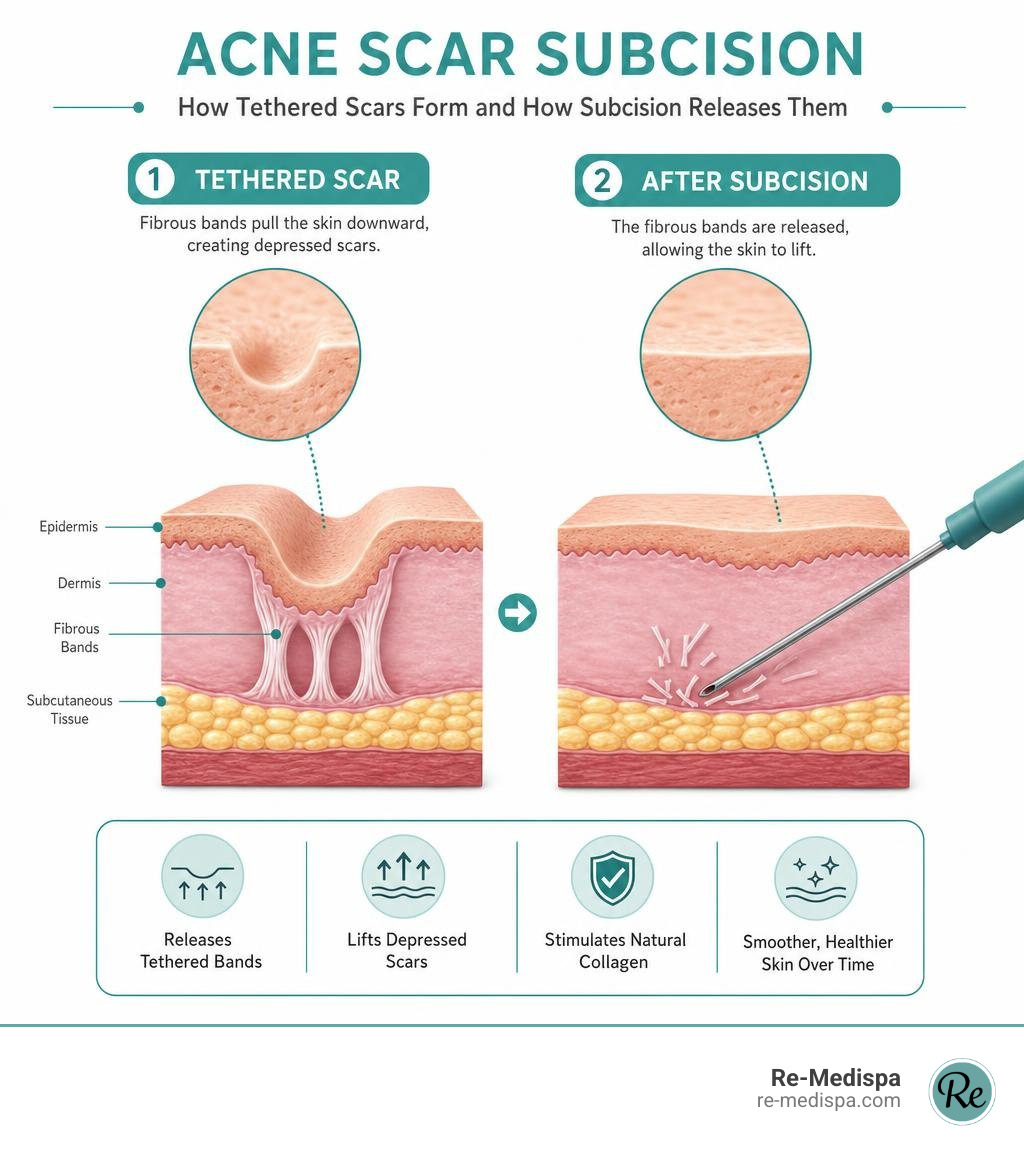
To understand why subcision is so effective, it helps to look at what is happening beneath the surface of your skin. When severe acne cysts or nodules heal, they often leave behind dense, vertical bands of collagen. These fibrous bands act like tiny, tight rubber bands, anchoring the top layer of your skin to the deeper subcutaneous tissue.
During an acne scar subcision treatment, a licensed provider inserts a specialized needle or a thin, blunt tube called a cannula just beneath the skin’s surface. By moving the instrument back and forth in a careful, fan-like motion, the provider mechanically cuts or releases these restrictive bands. You might even hear a distinct popping or snapping sound during the procedure, which is a normal and highly satisfying sign that the tethered bands are successfully breaking.
Once these bands are severed, the tension is released, and the depressed skin immediately begins to lift. This action also triggers a natural wound-healing response. Your body rushes to repair the micro-injuries beneath the surface, resulting in a surge of natural collagen and elastin production. Over the following weeks, this new collagen fills in the empty space beneath the scar, smoothing out your skin texture from the inside out. For more technical details on how this process works, you can read DermNet NZ’s clinical overview of subcision.
Who is the Ideal Candidate for Acne Scar Subcision Treatment?
Subcision is highly specialized, meaning it is incredibly effective for specific types of scarring but less helpful for others. The absolute best candidates for this treatment are individuals with rolling scars. These are broad, shallow depressions with smooth, gently sloping edges that give the skin an uneven, undulating appearance.
We also see excellent results in clients with shallow-to-medium boxcar scars, which are wider depressions with sharp, vertical borders. However, subcision is generally not recommended for deep, narrow “ice-pick” scars or raised, hypertrophic scars. Ice-pick scars require surface-tightening or rebuilding treatments like TCA CROSS, while raised scars require smoothing therapies.
One of the greatest advantages of subcision is that it is safe and highly effective for all skin tones. Many aggressive laser resurfacing treatments carry a risk of hyperpigmentation in darker skin types, but because subcision works entirely beneath the surface of the skin, it preserves the pigment layer.
Before moving forward, your provider will ensure you do not have any active acne breakouts, bleeding disorders, or active skin infections. It is also important that you have been off oral retinoids (such as isotretinoin) for at least six months. If you are currently dealing with active breakouts alongside your scarring, we recommend starting with targeted clinical facials and professional therapies to calm the skin first. You can explore our full range of customizable options on our skin care services page.
Traditional Needle vs. Blunt Cannula Subcision
Historically, providers performed subcision using a specialized tri-beveled needle, often referred to as a Nokor needle. While the Nokor needle is highly effective at slicing through tough, fibrous bands, its sharp edges carry a higher risk of nicking tiny blood vessels beneath the skin. This can lead to more significant bruising, swelling, and the formation of larger hematomas (pockets of blood under the skin).
In recent years, the medical aesthetics community has increasingly adopted blunt cannula subcision. Instead of a sharp needle, the provider uses a flexible, blunt-tipped tube. This cannula is inserted through a tiny single-entry puncture point. Because the tip is blunt, it naturally pushes past blood vessels and nerves rather than cutting them, dramatically reducing the risk of bleeding and bruising.
According to a comprehensive systematic review of subcision clinical trials, blunt cannula subcision resulted in an impressive 85% improvement rate in rolling acne scars, compared to a 39% improvement rate for traditional needle subcision. While both methods have their place depending on the thickness of your scar tissue, the cannula approach is often preferred for its safety profile and significantly shorter recovery time.
| Feature | Nokor Needle Subcision | Blunt Cannula Subcision |
|---|---|---|
| Tool Type | Sharp, tri-beveled surgical needle | Flexible, blunt-tipped tube |
| Puncture Points | Multiple entry points across the face | Single or minimal entry points |
| Risk of Bruising | Higher, due to sharp edges cutting blood vessels | Lower, as blunt tip bypasses blood vessels |
| Downtime | Typically 7–14 days of visible bruising | Typically 3–7 days of mild swelling |
| Clinical Efficacy | Highly effective for dense, isolated scars | Excellent for widespread rolling scars (85% improvement) |
Regardless of the tool used, a small, controlled amount of bleeding beneath the scar is actually beneficial. The pocket of blood acts as a temporary natural spacer, preventing the skin from immediately sticking back down and re-tethering to the deep tissue while new collagen begins to form.
Combining Subcision with Lasers and Microneedling for Enhanced Results
While subcision is the gold standard for releasing deep, structural anchors, it does not directly treat the very top layer of your skin. If you have surface texture issues, enlarged pores, or shallow pitting alongside your deep rolling scars, a combination approach is almost always the most effective path forward.

By combining subcision with surface-remodeling treatments like fractional lasers or radiofrequency (RF) microneedling, we can address your scars on multiple levels simultaneously. Subcision releases the deep, pulling forces from below, while microneedling or lasers rebuild and smooth the skin from the top down. This creates a powerful, synergistic effect that maximizes your overall skin rejuvenation.
Clinical data strongly supports these combination therapies. For instance, studies show that combining subcision with microneedling leads to visible improvement in 100% of treated patients, compared to just 77.1% of patients who underwent microneedling alone. Similarly, combining subcision with fractionated microneedle radiofrequency has been proven statistically more effective at repairing deep atrophic scars than utilizing radiofrequency microneedling on its own. If you are interested in exploring how these advanced energy devices can tighten your skin and rebuild lost collagen, read more about our skin tightening treatments.
What to Expect: Side Effects, Recovery, and Safety Considerations
Because subcision involves working beneath the skin, it is normal to experience some temporary side effects. In the first few days following your procedure, you should expect moderate swelling, mild soreness, and bruising. The extent of the bruising depends largely on whether your provider utilized a needle or a blunt cannula, as well as your personal tendency to bruise.
Most clients find that the majority of the swelling and visible bruising subsides within 5 to 7 days, though some mild, residual discoloration can occasionally last into the second week. To minimize your risk of bleeding and bruising, we recommend avoiding blood-thinning supplements and over-the-counter anti-inflammatories (like aspirin or ibuprofen) for two weeks prior to your appointment, under the guidance of your prescribing physician.
To ensure your skin heals beautifully and to prevent post-inflammatory hyperpigmentation (temporary dark spots), daily sun protection is absolutely non-negotiable. You should apply a broad-spectrum SPF 50 sunscreen daily and avoid direct sun exposure for at least two weeks after your session. Keeping your skin clean and properly hydrated is also vital to prevent infection. If you want to keep your skin in peak condition and ensure your pores remain clear during the healing process, you can learn more about our professional deep pore cleansing treatments.
What Results Can You Expect from Acne Scar Subcision Treatment?
It is important to remember that scar revision is a journey rather than an overnight fix. While you may notice an immediate lift in your scars due to the initial swelling and the physical release of the fibrous bands, your true, long-term results will develop gradually over several months.
As your body undergoes the process of collagen synthesis, you will see a progressive smoothing of your skin’s overall texture. Because the mechanical release of the scar tissue is structural, the improvements achieved through subcision are long-lasting. Once those restrictive bands are broken and the area is filled with your own natural collagen, the skin remains lifted, providing a permanent improvement in the smooth contour of your face.
Frequently Asked Questions
Is acne scar subcision painful?
We prioritize your comfort at every step of the procedure. Before your treatment begins, we apply a highly effective, prescription-strength topical numbing cream to the area for 30 to 45 minutes. Once the skin is prepped, your provider will gently administer a local anesthetic (such as lidocaine) to completely numb the treatment area. Because of this thorough numbing process, the procedure itself is virtually painless. You may feel a mild tugging sensation or hear a popping sound, but you should not feel sharp pain. Afterward, any mild soreness can be easily managed with over-the-counter pain relievers.
How many subcision sessions are typically needed?
The exact number of sessions required depends entirely on the depth, quantity, and severity of your scars, as well as your body’s unique ability to produce new collagen. While some clients see pleasing improvements after just one session, most individuals with moderate-to-severe scarring achieve their optimal results with a series of 2 to 4 sessions. We typically space these treatments 4 to 6 weeks apart to give your skin ample time to heal and build new collagen between appointments.
Can subcision be combined with dermal fillers?
Absolutely. In fact, combining subcision with temporary hyaluronic acid dermal fillers is one of the most popular and effective protocols in aesthetic medicine. When we inject a small amount of filler directly under the released scar, it acts as a physical barrier. This temporary gel “spacer” prevents the raw tissue from healing back together and re-tethering to the deeper structures. It also provides immediate, gratifying volume to lift the depression while your body works on building its own permanent collagen. Clinical studies show that combining subcision with hyaluronic acid filler leads to a 94% improvement rate in acne scars, compared to a 67.3% improvement rate for subcision alone.
Erase Your Acne Scars at Re-Medispa
At Re-Medispa, we understand that acne scars are more than just a surface-level concern — they can deeply impact your daily confidence. Led by our Founder and Medical Director, Renata Ciszek, our experienced team is dedicated to providing honest, highly personalized care to help you achieve the smooth, radiant skin you deserve.
We serve clients throughout the Chicagoland area from our two convenient clinical locations:
- Arlington Heights: 37 S Evergreen Ave, Arlington Heights, IL 60005
- Harwood Heights: 5128 N Harlem Ave, Harwood Heights, IL 60706
Whether you live in Arlington Heights, Harwood Heights, or nearby Northwest suburbs like Palatine, Schaumburg, Park Ridge, or Mount Prospect, we make it easy to access advanced aesthetic treatments in a warm, welcoming environment. During your comprehensive consultation, we will assess your unique scar type and use our advanced AI preview tool to help you visualize your potential treatment outcomes.
If you are ready to take the first step toward smoother, healthier skin and want to see if an acne scar subcision treatment is the right choice for you, we invite you to schedule a consultation at our medical spa today.