
What Is the average Botox forehead units — and Why Does It Matter?
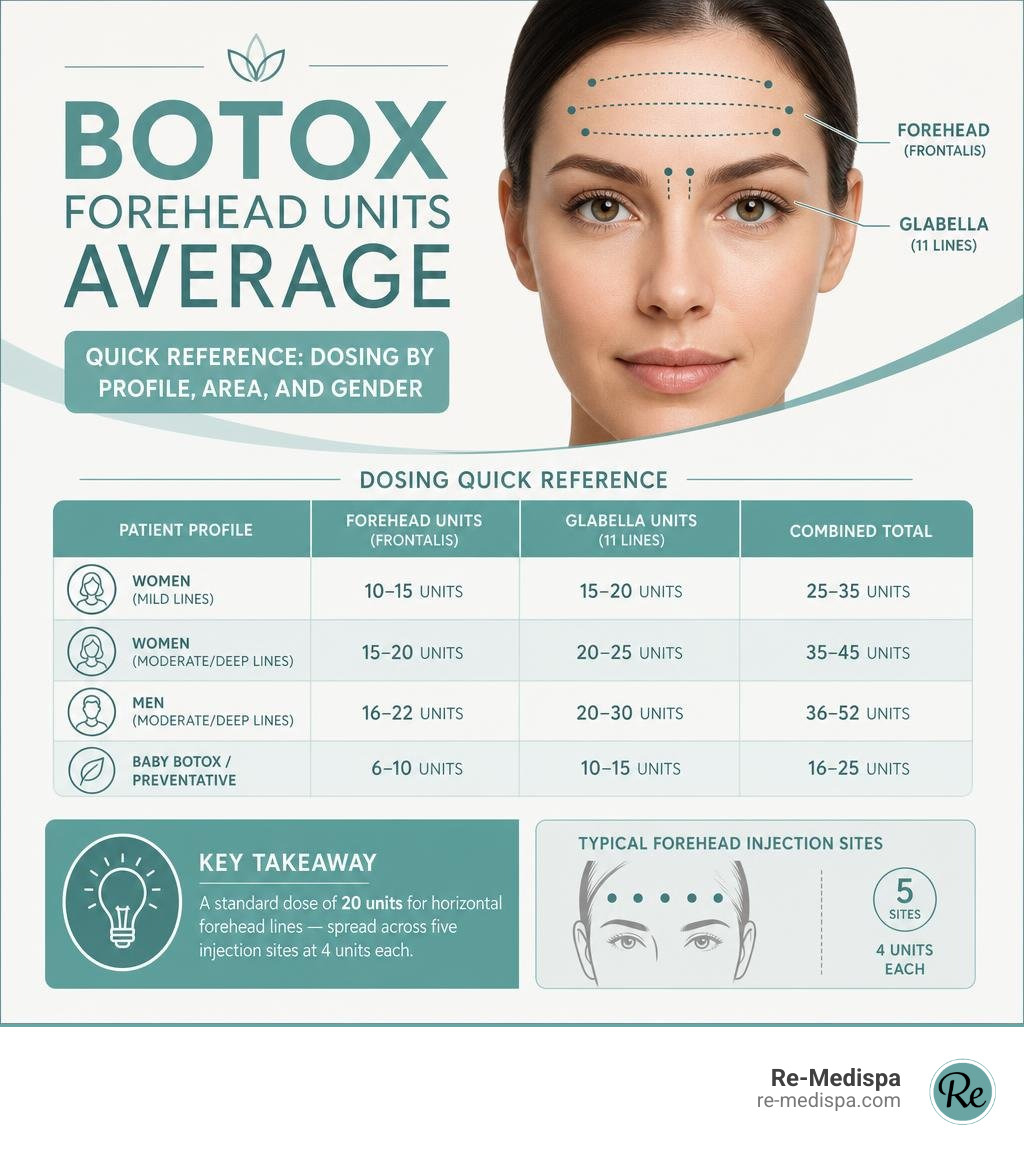
The Average Botox forehead units falls between 10 and 30 units, depending on your muscle strength, forehead size, wrinkle depth, and treatment goals. Here’s a quick reference:
| Patient Profile | Forehead Units (Frontalis) | Glabella Units (11 Lines) | Combined Total |
|---|---|---|---|
| Women (mild lines) | 10–15 units | 15–20 units | 25–35 units |
| Women (moderate/deep lines) | 15–20 units | 20–25 units | 35–45 units |
| Men (moderate/deep lines) | 16–22 units | 20–30 units | 36–52 units |
| Baby Botox / Preventative | 6–10 units | 10–15 units | 16–25 units |
Key takeaway: Allergan, the manufacturer of Botox Cosmetic, recommends a standard dose of 20 units for horizontal forehead lines — spread across five injection sites at 4 units each.
But that number is just a starting point. Most experienced injectors personalize your dose based on your anatomy and goals — not a one-size-fits-all protocol.
If you’ve ever compared notes with a friend and wondered why she got “12 units” and you were quoted “25,” you’re not alone. That kind of confusion is incredibly common — and it usually comes down to which muscles were treated and how active they are. Someone saying “I got 12 units” without specifying the treated area is, as practitioners put it, a bit like comparing apples to oranges.
The right unit count isn’t just about smoothing lines. It’s about keeping your face looking like you — just more rested.
Average Botox forehead units terms at a glance:
Understanding the average Botox forehead units
When we talk about forehead Botox, we are specifically targeting the frontalis muscle. This is the large, broad muscle responsible for raising your eyebrows and creating those horizontal lines when you look surprised. Because it is a highly active muscle, finding the right balance is essential to keep your expressions looking natural.
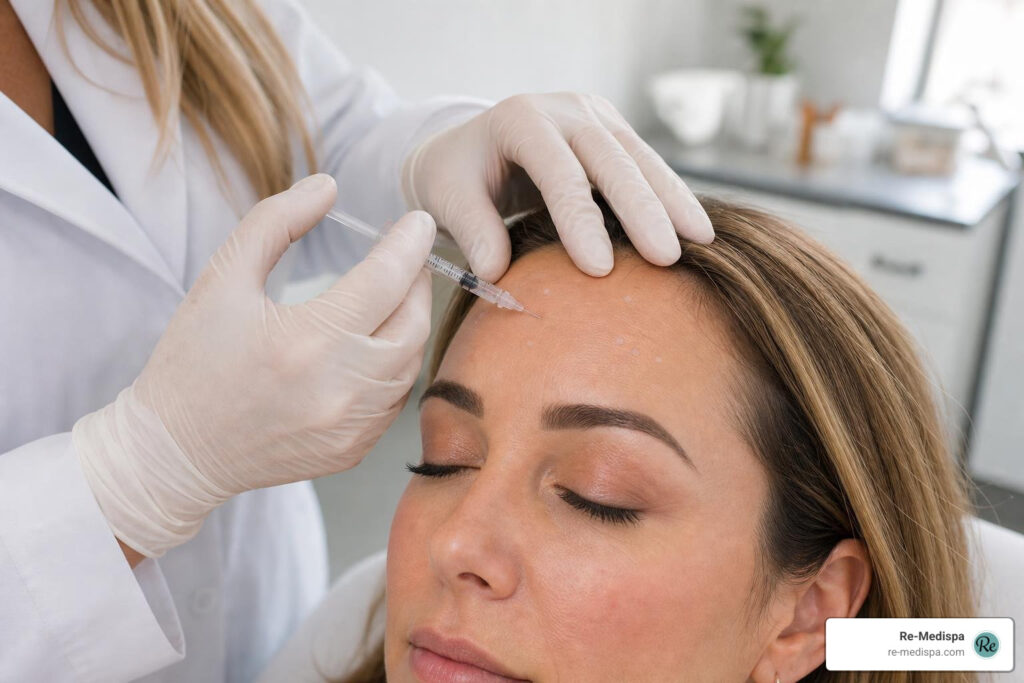
The official FDA-approved dosing guidelines from Allergan suggest a standard of 20 units for horizontal forehead lines. This protocol usually involves distributing 4 units across five precise injection sites. However, clinical averages in real-world practices often range from 10 to 30 units depending on the individual.
According to a clinical review by Dermatology Sense, treating this area requires a customized approach rather than a rigid template. Every forehead is unique, and injecting a standard dose without assessing your natural movement can lead to suboptimal results.
To understand how we approach this delicate area to maintain expression while smoothing lines, you can read The No-Nonsense Guide to Smoothing Out Forehead Lines. We prioritize a tailored plan that respects your unique facial structure.
Key Factors That Influence Your Forehead Botox Dosage
Your facial anatomy is as unique as your fingerprint, which is why there is no single magic number for Botox. Several anatomical and lifestyle factors play a direct role in determining how many units you will need for your treatment.
First, muscle mass and thickness dictate how much product is required to temporarily relax the area. Stronger, bulkier muscles naturally require a higher dose to achieve the same smoothing effect as finer, thinner muscles.
Forehead height and shape also influence the injection pattern and unit count. A taller forehead has a larger surface area and more muscle fibers to address, requiring more injection points to achieve an even, balanced result.
Additionally, the depth of your wrinkles—whether they are dynamic (only showing when you move) or static (visible even when your face is completely relaxed)—will shift the plan. Your personal aesthetic goals, such as wanting a completely smooth look versus maintaining a soft, expressive movement, will guide the final dosage.
| Dosing Factor | Female Patients | Male Patients |
|---|---|---|
| Average Muscle Mass | Typically lower; finer muscle fibers | Typically higher; thicker, bulkier muscle fibers |
| Forehead Height & Width | Generally smaller surface area | Generally larger, wider surface area |
| Typical Dose Range | 10 to 20 units for frontalis | 16 to 22 units for frontalis |
| Glabella Pull Strength | Moderate | High; stronger frown muscle action |
Why First-Time Patients Start Below the average Botox forehead units
If you are new to cosmetic injectables, we always recommend starting with a more conservative dose. This allows us to establish a baseline response and see exactly how your unique muscles react to the neuromodulator.
Starting below the clinical average is a safe, smart strategy because we can always add more units at a two-week touch-up session if needed. However, if too much product is administered initially, there is no way to reverse the effects; you simply have to wait for them to wear off.
This cautious approach ensures we preserve your natural expressions while gently softening lines. To explore how we prioritize patient safety and natural results across all cosmetic treatments, review our Step-by-Step Guide to Safe Injectable Options.
How Age and Muscle Strength Shift the average Botox forehead units
Your age group and the natural aging process of your skin significantly influence your required dosage. In your 20s and early 30s, treatments are often preventative, focusing on training the muscles before deep creases can form.
As we move into our 40s and 50s, skin elasticity naturally decreases, and dynamic lines can gradually transition into static wrinkles. This shift means that older skin may require a combination of strategic dosing and consistent maintenance to achieve optimal smoothing.
According to the Botox Dosage Guide (2026) by InjectCo, muscle thickness and skin elasticity are the primary drivers of dosage changes over time. Understanding these shifts helps us design a treatment plan that evolves gracefully alongside your skin.
The Importance of Treating the Glabella and Forehead Together

One of the most common mistakes in facial aesthetics is treating the forehead in isolation. The muscles of the upper face operate in a delicate tug-of-war system of opposing forces.
The frontalis muscle is an elevator—its sole job is to pull your eyebrows upward. Conversely, the muscles in the glabella (the area between your eyebrows, often called the “11 lines”) are depressors, meaning they pull your eyebrows downward.
If you relax only the frontalis muscle, you eliminate the upward pull while leaving the downward pull of the glabella completely unopposed. This imbalance can cause the eyebrows to feel heavy and droop, creating a tired or stern appearance known as brow ptosis.
By treating both the forehead and the glabella during the same session, we maintain a beautiful, harmonious balance. To learn more about how we achieve this facial harmony at our Chicagoland locations, explore our dedicated page on Botox Arlington Heights IL Harwood Heights IL.
Baby Botox vs. Standard Dosage: Finding Your Balance
“Baby Botox” has become incredibly popular for those seeking a highly subtle, refreshed look. This technique involves micro-dosing, where we use significantly fewer units (typically 6 to 10 units in the forehead) spread out across the area.
The primary goal of Baby Botox is to soften very mild, early lines while preserving a high degree of natural facial movement. It is an excellent option for younger clients, first-time patients, or anyone who wants to ensure their expressions remain completely active.
A standard dosage, on the other hand, is designed for moderate to deep wrinkles and offers more comprehensive smoothing. While a standard dose provides longer-lasting results, it requires a highly skilled hand to ensure your face still looks warm and expressive rather than completely frozen.
Potential Side Effects and Safety Considerations
While Botox is a highly safe, FDA-approved treatment, it is still a medical procedure that carries potential risks if performed incorrectly. Understanding these risks is an important part of making an informed decision for your skin.
Common, mild side effects are temporary and typically resolve within a few days. These can include:
- Mild swelling or redness at the injection sites
- Temporary bruising
- A light, transient headache immediately following treatment
More significant complications, such as eyelid ptosis (drooping of the eyelid) or a heavy brow, are almost always the result of incorrect dosing or poor injection placement. If too many units are placed too low on the forehead, the frontalis muscle can over-relax, pushing the eyebrows downward.
This is why choosing a highly trained, licensed professional is absolutely critical. An experienced injector understands facial anatomy deeply and knows exactly where to place each unit to keep your eyes looking bright and open.
Frequently Asked Questions About Forehead Botox
We believe that education is the foundation of great aesthetic care. Here are some of the most common questions we hear from our clients in the Northwest suburbs.
How long do forehead Botox results typically last?
For most clients, the visible smoothing effects of forehead Botox last between 3 to 4 months. However, several individual factors can influence this timeline, including your personal metabolism, physical activity levels, and how active your facial muscles are.
First-time patients may notice that their initial treatment wears off a bit faster, sometimes around the 2.5 to 3-month mark, as the muscles adapt. With consistent, regular treatments, the muscles gradually become trained to stay relaxed, which can extend the longevity of your results up to 4 or 5 months.
What happens if you use too many or too few units?
Using too many units in the forehead can lead to a “frozen” look, making it difficult to show natural expressions, or it can cause your brows to feel incredibly heavy. Because there is no chemical reversal agent for Botox, you simply have to wait for the product to naturally metabolize over several weeks.
Conversely, using too few units—often referred to as under-dosing—means your results may fade very quickly, sometimes within 4 to 8 weeks. It can also lead to asymmetrical results or uneven muscle movement as the untreated muscle fibers attempt to compensate.
Does Dysport require the same number of units as Botox?
No, Dysport and Botox are formulated differently and do not use the same unit measurements. Dysport utilizes smaller active proteins, meaning it typically requires a conversion ratio of approximately 2.5 to 3 units of Dysport to equal the strength of 1 unit of Botox.
While the unit counts will look much higher on your chart if you choose Dysport, the actual clinical strength and final aesthetic outcome are highly comparable. Your provider will calculate the exact conversion to ensure you receive the perfect dosage for your goals.
Personalized Aesthetic Care at Re-Medispa

At Re-Medispa, we believe that aesthetic medicine should never be about fitting into a standard mold. Led by our founder and medical director, Renata Ciszek, we provide honest, personalized care designed to enhance your natural beauty while keeping you looking like yourself.
Our state-of-the-art medical spas in Arlington Heights and Harwood Heights, IL, serve clients from across the Northwest suburbs, including Palatine, Schaumburg, Park Ridge, and Glenview. To take the guesswork out of your treatment, we utilize an advanced AI preview tool during your consultation, allowing you to visualize your potential results before we ever begin.
We invite you to experience a warm, collaborative approach to facial rejuvenation. If you are ready to discuss your goals and find your perfect treatment plan, we welcome you to book a personalized consultation with us today to explore our full range of Injectables.