
Botox for Jawline Slimming: A Quick Overview
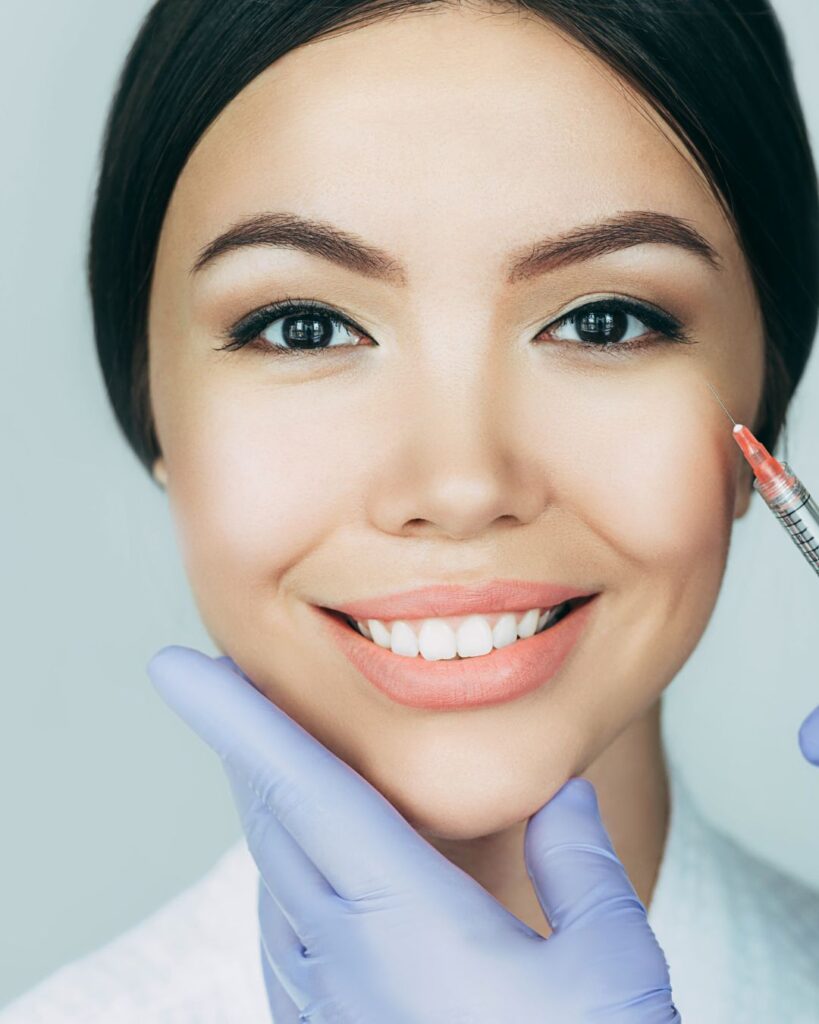
Botox for jawline slimming uses a neuromodulator injection to relax the masseter, the large muscle used for chewing at the back of your jaw. When a wide lower face is partly caused by an enlarged masseter muscle, many clients see a softer, narrower facial contour over time – without surgery and with little downtime.
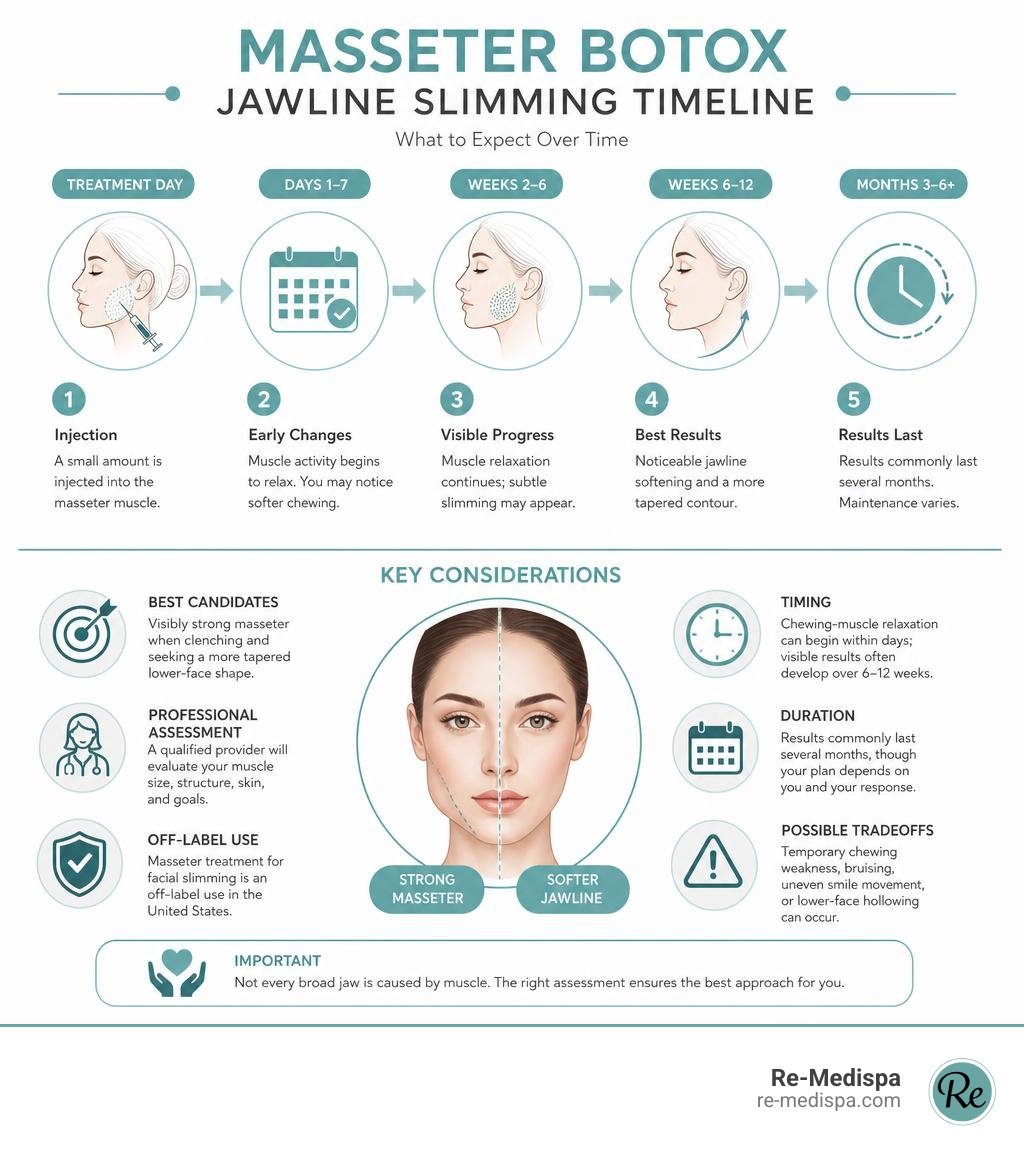
- How it works: A licensed professional injects the masseter muscle, reducing its activity so it may gradually decrease in size.
- When results appear: Chewing-muscle relaxation can begin within days, while visible facial slimming often develops over 6 to 12 weeks.
- How long it may last: Results commonly last several months, though your treatment plan depends on your anatomy, goals, and response.
- Important to know: Masseter treatment for facial slimming is an off-label use of Botox in the United States. It should be performed only after a careful consultation with a qualified, licensed provider.
- Possible tradeoffs: Temporary chewing weakness, bruising, uneven smile movement, or lower-face hollowing can occur. Not every broad jaw is caused by muscle, so the right assessment matters.
The best candidates usually have a visibly strong masseter when they clench their teeth and want a more tapered lower-face shape. At Re-Medispa, a licensed provider can assess whether muscle size, facial structure, skin laxity, or another factor is shaping your jawline before recommending treatment.
Botox for jawline slimming further reading:
How Botox for Jawline Slimming Works: Masseter Anatomy and Disuse Atrophy
The masseter muscle is one of the strongest muscles in your entire body relative to its size. Situated at the back of the jaw, it connects your cheekbone to your lower jawbone and handles the heavy lifting whenever you bite or chew.
When this muscle works overtime—due to stress-induced teeth grinding, clenching, or simply genetic luck—it undergoes hypertrophy, meaning the muscle fibers expand. This growth gives the lower face a wider, squarer appearance.
Injecting a neuromodulator into the masseter temporarily blocks nerve signals that command the muscle to contract tightly. You can still chew comfortably, but the muscle relaxes significantly.
Over time, this reduced workload causes disuse atrophy, a gentle process where the unworked muscle gradually shrinks in volume. To dive deeper into the mechanics of neurotoxins, read our guide on Neuromodulator Science How Botox and Dysport Actually Work.
Clinical research highlights how dramatic these volumetric changes can be over time. Studies reviewed in clinical literature, such as this Masseter Botox for facial slimming study, show that muscle volume typically reduces by 20% to 50% from baseline over a series of structured treatments.
Understanding Off-Label Usage and Safety
Many patients are surprised to learn that using botox for jawline slimming is considered an off-label application in the United States. While the FDA has approved Botox for upper facial lines and certain medical conditions, using it in the masseter muscle for facial contouring falls outside those explicit cosmetic labels.
Off-label prescribing is a common, entirely legal practice in medicine when backed by robust clinical experience and safety data. It simply means our medical team utilizes sound clinical judgment to treat an area not specifically named on the package insert.
Because off-label treatments require precise execution, selecting an experienced clinical provider is essential. Understanding facial anatomy prevents improper diffusion and ensures your aesthetic journey remains safe and satisfying.
Clinical Protocols: Dosing, Injections, and Demographic Variations
Achieving a natural, slim jawline requires custom dosing and exact anatomical mapping. There is no one-size-fits-all formula because every jaw muscle possesses a unique thickness and strength.
During a treatment session at Re-Medispa, our licensed practitioners identify the “lower posterior safe zone.” This safe region lies at least 1 centimeter in front of the back edge of the jaw and safely below the earlobe, staying far away from delicate facial expression muscles.
Providers typically use a 3-point or 5-point grid technique, inserting a fine needle deep into the belly of the masseter muscle. Standard dosing for aesthetic masseter reduction ranges between 25 and 50 units per side, with most first-time patients starting conservatively around 30 to 40 units per side. For more clinical insights on technique, explore this comprehensive Masseter Botox Guide.
Depending on your aesthetic preference and muscle dynamics, alternative neuromodulators may also be evaluated. Take a moment to compare options in our overview of Botox vs Dysport Which Neuromodulator Is Right for You.
How Gender and Age Impact Treatment Approaches
Facial structure varies considerably across genders and age groups, requiring tailored injection protocols.
- Female Patients: The primary goal is usually creating a delicate, oval, or heart-shaped taper. Injections are placed to slim the lower jaw while keeping the cheeks looking soft and youthful.
- Male Patients: Men often desire masseter relaxation to alleviate clenching without losing their sharp, masculine jaw angle. Dosing may be higher due to larger muscle mass, but injection patterns protect the defined gonial angle.
- Older Patients: As we age, skin naturally loses collagen and elasticity. Reducing underlying muscle mass too quickly in mature clients can sometimes unmask pre-existing skin laxity, making careful skin evaluation essential.
Functional Considerations: Bite Strength, Chewing Changes, and Jawbone Density
Because the masseter is an essential chewing muscle, relaxing it causes functional adjustments alongside aesthetic changes. It is completely normal to wonder how eating your favorite steak or crunchy apple might be affected.
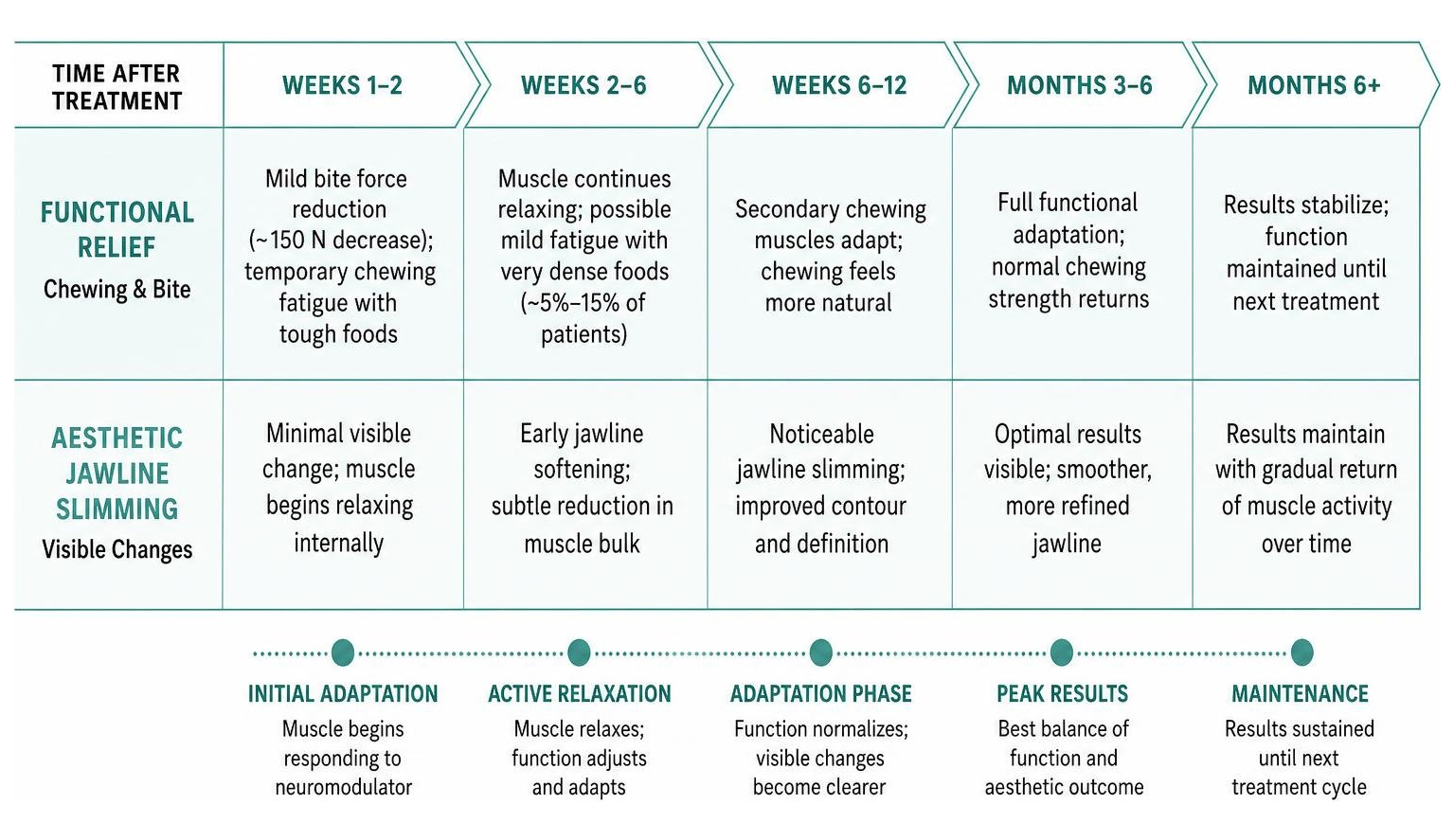
In the first two weeks following injection, maximum bite force temporarily decreases as the muscle adapts to the neuromodulator. Approximately 5% to 15% of patients report a mild, temporary feeling of fatigue when chewing dense or tough foods during weeks 2 through 6.
This functional change is temporary because your secondary chewing muscles—such as the temporalis muscle along the side of your head—easily step up to assist. As the weeks pass, chewing feels completely natural again.
Patients also frequently ask about long-term jawbone health. Research into repeated masseter injections indicates that while minor, reversible shifts in bone density can occur near muscle attachment points during prolonged treatment, normal bone integrity is maintained when treatments are properly spaced.
| Phase | Functional Impact | Aesthetic Impact |
|---|---|---|
| Weeks 1–2 | Mild bite force reduction (~150 N decrease); temporary chewing fatigue with tough foods | Minimal visible change; muscle begins relaxing internally |
| Weeks 3–4 | Chewing comfort normalizes as secondary muscles adjust | Initial softening of lower jawline width becomes noticeable |
| Weeks 6–12 | Full chewing capacity restored | Peak visible jawline slimming (20–50% muscle bulk reduction) |
| Months 4–6 | Normal muscle function completely returned | Slimming effect slowly tapers; touch-up may be planned |
Preventing Complications: Smile Asymmetry, Paradoxical Bulging, and Jowls
While masseter contouring is widely practiced and safe, understanding potential complications empowers you to make informed decisions. Addressing these risks openly ensures you know what to expect and how expert technique protects your smile.
One common myth is that masseter injections permanently ruin your smile or cause severe face sagging. In reality, side effects are usually temporary and preventable when treatment is performed by a skilled provider.
- Smile Asymmetry: If neuromodulator solution diffuses forward into the risorius or buccinator muscles—which pull the corners of your mouth sideways—it can create a temporary crooked smile. Precise depth and staying strictly within the safe zone prevents this issue. If it occurs, it typically resolves on its own within 4 to 8 weeks.
- Paradoxical Bulging: Occasionally, 1 to 3 weeks after treatment, a firm bump appears when you clench. This happens when the superficial muscle layer relaxes while deeper fibers compensate by flexing harder. It is easily fixed during a quick touch-up visit with a few additional units injected into the flexing bulge.
- Jowls or Sagging: When a large masseter muscle shrinks significantly, the overlying skin loses some structural support. In clients with lower skin elasticity or thin subcutaneous fat, this can cause mild sagging or pre-auricular hollowing.
Evaluating skin bounce-back before injecting helps prevent unwanted lower-face descent. Mild temporary swelling or minor bruising at injection sites affects roughly 5% to 10% of patients and fades within days.
Patient Selection and Consultation Guide
Determining whether you are an ideal candidate for botox for jawline slimming starts with a hands-on clinical evaluation. Not every square or wide jawline stems from hypertrophic muscle mass.
During your consultation, our team performs the “clench test.” By placing fingers on the lower sides of your jaw while you bite down tightly, we can feel whether the masseter muscle is firm and thick or if your jaw structure is dictated primarily by skeletal bone shape or overlying soft tissue.
We also examine your full facial balance, skin tone, and medical background. If your wider jawline is primarily structural bone or subcutaneous fat, neuromodulators alone will not produce a slimmer outline.
Key Candidates for Botox for Jawline Slimming
You are likely a fantastic candidate for masseter relaxation if you exhibit:
- Distinct masseteric hypertrophy confirmed by the clench test.
- A square or boxy lower facial contour that you wish to soften into an oval shape.
- Symptoms of nocturnal teeth grinding (bruxism), such as morning jaw soreness or tension headaches.
- Visible asymmetrical jaw width caused by chewing predominantly on one side.
Who should avoid this treatment? Individuals with severe skin laxity, extremely low facial fat, active neuromuscular disorders, or those who are pregnant or breastfeeding should refrain from masseter injections.
What to Ask Your Provider Before Getting Botox for Jawline Slimming
Being an active participant in your aesthetic care ensures peace of mind. Here are key questions to ask during your consultation:
- Is my jaw width caused by masseter muscle bulk, bone structure, or facial fat?
- What injection landmarks do you use to avoid the muscles that control my smile?
- Based on my skin elasticity, am I at risk for lower-face sagging or pre-auricular hollowing?
- How do you manage touch-ups if I experience paradoxical bulging?
Asking these questions helps ensure your provider possesses deep anatomical knowledge and places your safety first.
Complementary Treatments and Results Timeline
Achieving a beautifully balanced lower face often involves looking at surrounding features. Masseter reduction slims the sides of the lower face, but combining it with chin or jawline enhancement can highlight your entire profile.
For example, pairing masseter treatment with chin filler can elongate a short chin, creating an elegant “V-line” contour. To learn more about structural filler options, explore our guide on Jawline Definition Combining Neuromodulators and Fillers or read about Chiseled and Defined Your Guide to Collagen Stimulating Jawline Fillers.
Understanding the transformation timeline keeps your expectations grounded:
- Days 1 to 7: The masseter begins to relax internally; jaw clenching tension decreases.
- Weeks 2 to 4: Bite strength adjusts; subtle softening of the outer jaw angle begins.
- Weeks 6 to 8: Visible lower-face slimming becomes noticeable to you and others.
- Months 3 to 4: Maximum aesthetic jaw slimming is reached.
- Months 4 to 6: Muscle activity slowly returns; repeat treatment maintains your refined contour.
If you are exploring comprehensive rejuvenation treatments, discover our full array of offerings under Dermal Fillers and browse our full suite of expert Injectables.
Frequently Asked Questions About Masseter Contouring
How many units are required for jawline reduction?
Most adult patients require between 25 and 50 units of Botox per side (50 to 100 units total) for effective masseter reduction. First-time patients usually start conservatively with 30 to 40 units per side. Your specific dosage is determined by a licensed professional during your consultation based on muscle volume and strength.
How long do visible facial slimming results last?
The visible slimming effect typically lasts 4 to 6 months. While muscle relaxation starts wearing off around month 3 or 4, disuse atrophy keeps the muscle smaller for several additional weeks. Regular maintenance treatments every 6 months can help sustain long-lasting jawline refinement.
Can masseter injections cause a crooked smile?
Smile asymmetry is a rare complication that occurs only if the neuromodulator diffuses forward into the risorius or zygomaticus muscles. Choosing an experienced practitioner who adheres strictly to the lower posterior safe zone minimizes this risk. If it occurs, it is temporary and dissipates within 4 to 8 weeks.
Conclusion
Deciding to pursue botox for jawline slimming is a personal journey that blends aesthetic sculpting with functional comfort. By understanding masseter anatomy, realistic timelines, and proper safety protocols, you can approach your aesthetic goals with complete confidence.
At Re-Medispa, our care approach prioritizes honest, personalized consultations tailored to your unique anatomical structure. Led by Medical Director Renata Ciszek, our experienced team takes the time to assess your facial balance, skin health, and muscle strength to craft a treatment plan designed specifically for you.
We invite you to visit our state-of-the-art facilities located in Arlington Heights at 37 S Evergreen Ave or Harwood Heights at 5128 N Harlem Ave. Schedule your consultation today with Re-Medispa to explore how our specialized medical spa services can help you look and feel your absolute best. Explore our full menu of services at our main Medical Spa page or book your dedicated Botox consultation.