
Preventative Botox: Starting Early Without Aging Yourself
Why More Women Are Thinking About Forehead Wrinkles Before They Appear
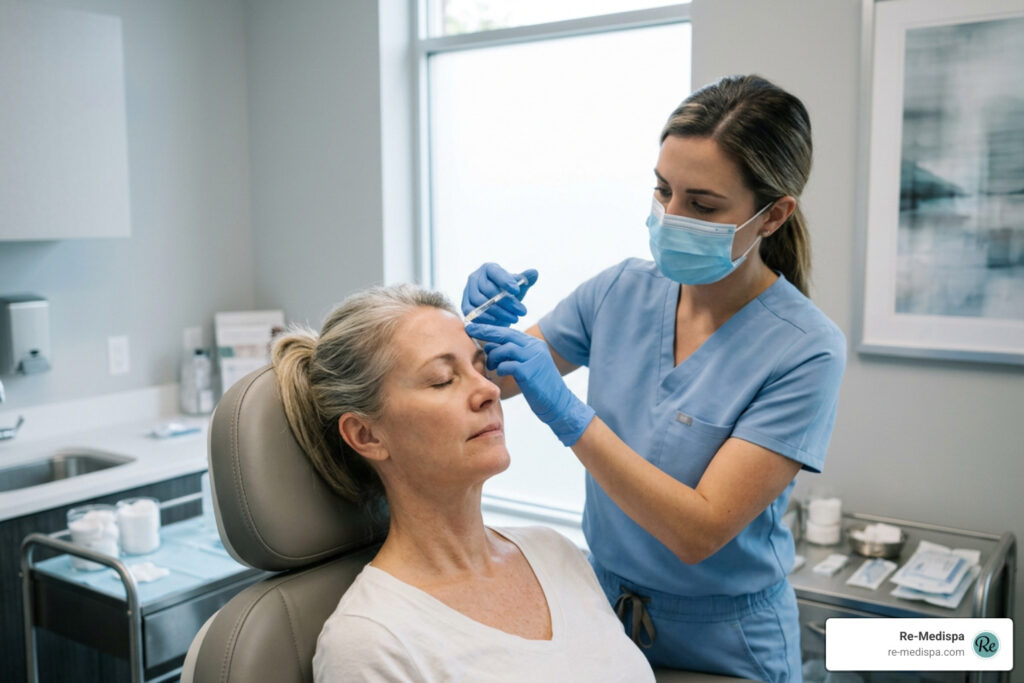
Botox for forehead prevention is one of the fastest-growing aesthetic trends — and for good reason. Wrinkles are far easier to prevent than to erase.
Here’s a quick answer to what you need to know:
- What it is: Low-dose Botox injections that relax forehead muscles before deep lines set in permanently
- Who it’s for: Adults (typically 25–35) who notice faint lines forming during facial expressions — especially when frowning or raising their brows
- How it works: By temporarily reducing muscle movement, Botox stops repetitive creasing from turning into etched, static wrinkles
- How often: Most people need treatments every 3–4 months to maintain results
- Key risk to know: Too much, too soon can weaken muscles over time and actually accelerate visible aging — conservative dosing is essential
- Does it work? A 2006 twin study showed that after 12 years of regular Botox, the treated twin had noticeably fewer wrinkles — even months after her last treatment faded
Forehead lines start as dynamic wrinkles — lines that only appear when your face moves. Over time, especially as collagen drops roughly 1% per year starting in your 30s, those expression lines stop disappearing when your face relaxes. That’s when they become static wrinkles — and they’re much harder to treat.
The goal of preventative Botox isn’t to freeze your face. It’s to stay ahead of that transition.
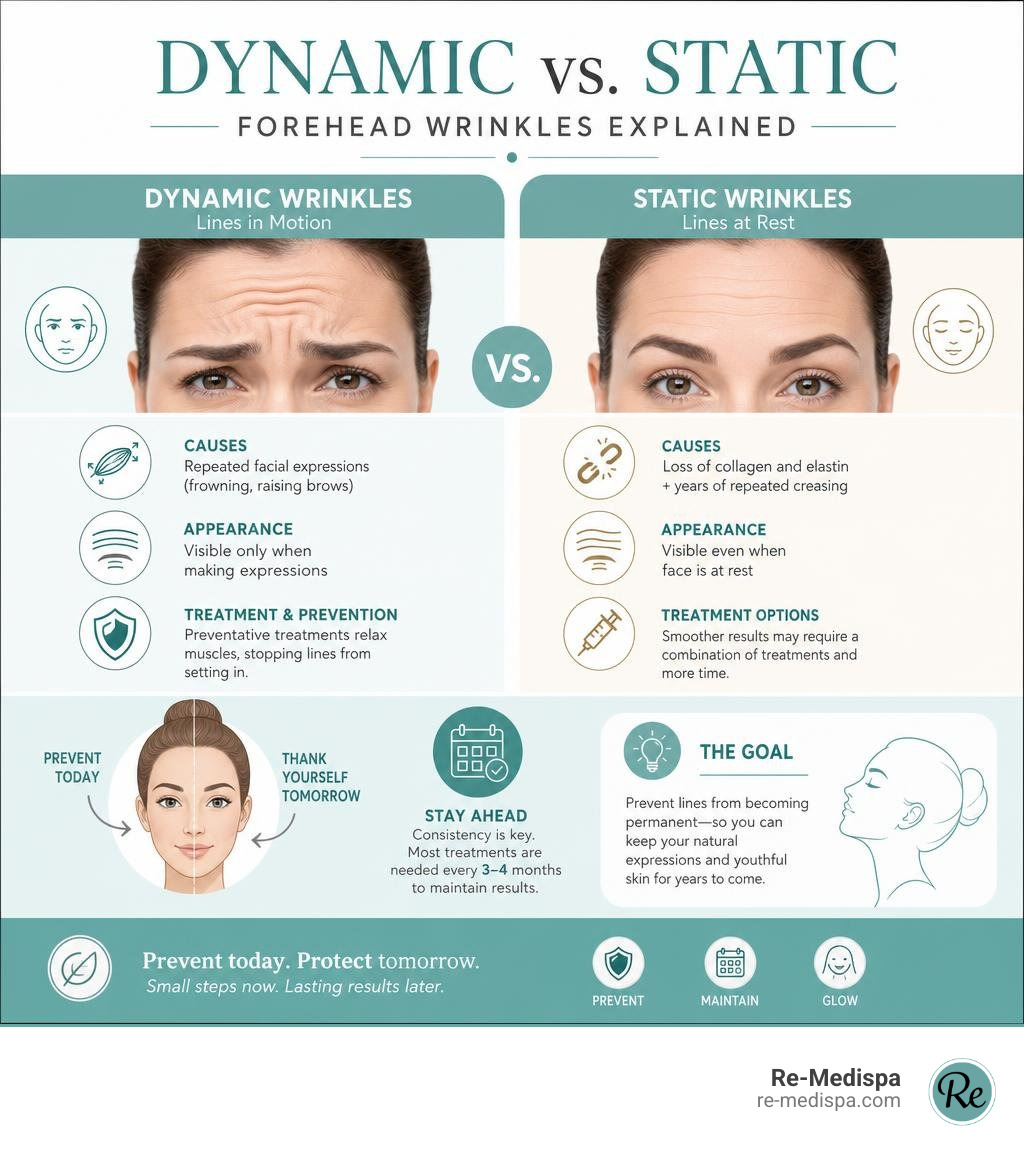
Know your botox for forehead prevention terms:
What is Preventative Botox and How Does It Work?
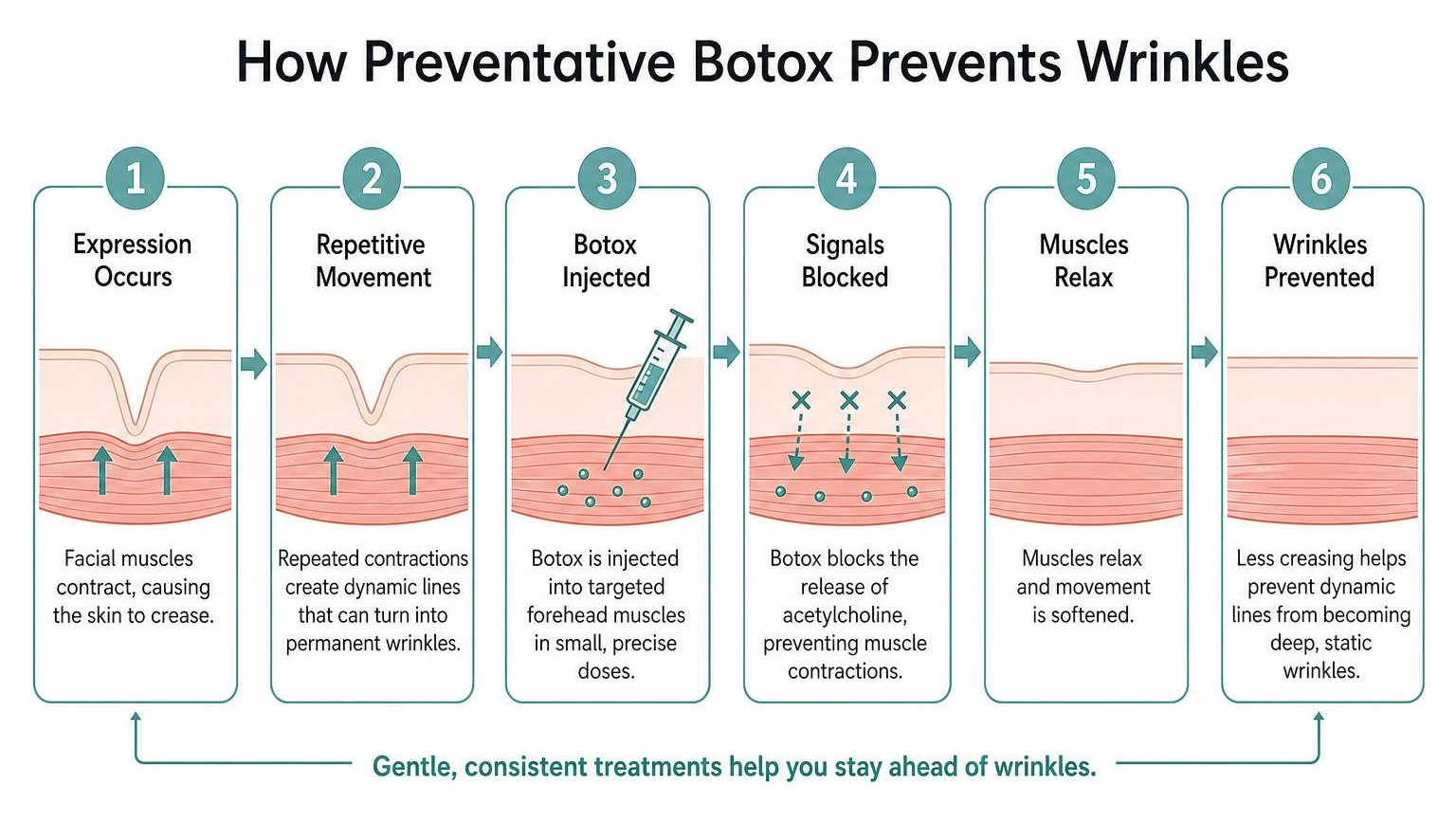
To understand how botox for forehead prevention works, we have to look at how your nerves communicate with your muscles. Every time you squint, frown, or raise your eyebrows in surprise, your brain sends a chemical messenger called acetylcholine to your facial muscles. This signal tells the muscles to contract, which in turn creases the overlying skin.
When we inject tiny, targeted doses of an FDA-approved neuromodulator, it temporarily blocks the release of acetylcholine. Without this chemical trigger, the treated muscle relaxes, allowing the skin above it to rest and recover. To learn more about this biological process, you can read our detailed guide on Neuromodulator Science: How Botox and Dysport Actually Work.
This treatment serves as a form of physical behavior modification. By gently limiting the intensity of your expressions, you naturally break the habit of furrowing your brow or raising your forehead. Over time, your muscles learn to move more softly, which helps protect your skin from future creasing.
While the concept of treating wrinkles before they fully form was once debated, clinical experience has shown its clear benefits. For a deeper look into the medical consensus, you can explore the discussion on Fact or myth: Does preventative Botox actually work? | ASPS.
The Science of Botox for Forehead Prevention
The forehead is a complex muscular landscape, and treating it requires an artistic touch backed by rigorous anatomical knowledge. The primary muscle we target is the frontalis, which is a broad, thin muscle responsible for raising your eyebrows and creating those horizontal lines across your forehead.
The frontalis muscle does not act alone; it works in constant opposition to your brow depressors, such as the corrugator and procerus muscles. If we relax the frontalis without considering these opposing forces, your eyebrows can feel heavy or look unnaturally flat. Furthermore, the frontalis exhibits a transitional line of movement known as the “C-line,” where the upward and downward forces of the forehead meet.
Understanding these structural nuances is essential for delivering a natural look. According to clinical research, such as the study on Why, When, and How to Treat Dynamic Forehead Lines with Botulinum Toxin Type A, every injection must be placed precisely to preserve your natural expressions.
As we age, our skin naturally loses its elasticity and structural support. This is why younger generations are changing their approach to aging. To understand this shift, read our article on Preventative Botox: Why Millennials Are Starting Earlier.
When to Start and What to Expect
There is no single “perfect” age to start preventative treatments. Instead, the decision should be based on your unique facial anatomy, genetics, and muscle activity. For some, dynamic lines begin to linger even when the face is completely relaxed in their late 20s or early 30s.
When you choose to address these lines early, your experience will differ significantly from corrective treatments designed for older skin. Before booking your first session, it is helpful to understand the full journey, which you can read about in our Complete Guide to Botox: What to Expect Before, During, and After.
To help you visualize the differences, we have compared the two approaches below:
| Feature | Preventative Botox | Corrective Botox |
|---|---|---|
| Primary Goal | Stop dynamic lines from etching into static wrinkles | Soften and smooth existing, deep-set static wrinkles |
| Target Age Group | Typically mid-20s to mid-30s | Typically late 30s, 40s, and beyond |
| Dosing Strategy | Conservative, lower doses (“Baby Botox”) | Standard, full therapeutic doses |
| Skin Quality | High natural collagen and skin elasticity | Naturally declining collagen and thinning skin |
| Expected Result | Subtle relaxation with full facial expression preserved | Significant smoothing of deep lines, highly refreshed look |
Is 20 Too Early for Botox for Forehead Prevention?
We are often asked if patients in their early 20s should start getting injections. In almost all cases, treating skin that has zero visible creasing or dynamic lines is unnecessary. Starting too early can lead to unnecessary costs and, in rare cases, can even cause the targeted muscles to weaken prematurely.
However, if you have highly active facial muscles or a strong family history of deep forehead creasing, a professional evaluation is the best way to determine your needs. The long-term benefits of early, consistent treatment are well-documented.
For instance, a famous multi-year study on identical twins demonstrated that the twin who received regular treatments over a 12-year period had significantly fewer resting forehead lines than her untreated sister. You can read more about the clinical tracking of these long-term outcomes in the research published on Checking your browser – reCAPTCHA.
Finding the Right Dose of Botox for Forehead Prevention
When it comes to botox for forehead prevention, our clinical philosophy is always “less is more.” We often utilize a technique known as “Baby Botox,” which involves using micro-doses of the neuromodulator distributed across more injection points. This approach softens muscle contractions without completely freezing your brow.
The standard FDA-recommended dose for fully treating forehead lines in conjunction with frown lines is 40 Units. However, for preventative purposes, a licensed professional will often customize a much smaller dose based on your forehead height, muscle strength, and goals.
In some cases, alternative neuromodulators may be recommended to achieve the softest, most natural spread. To see why this matters, read our article on Why Dysport May Work Better for Forehead Lines.
Risks, Side Effects, and the Danger of Over-Treatment
While Botox is highly safe and FDA-approved, it is still a medical procedure that carries potential risks. The most common side effects associated with forehead treatments include temporary headaches (occurring in about 9% of clinical cases) and mild bruising or swelling at the injection sites.

A major risk of over-treating the forehead is brow ptosis, which is a temporary drooping of the eyebrow that occurs in about 2% of cases. This typically happens when injections are placed too low on the forehead, interfering with the frontalis muscle’s ability to lift the brow.
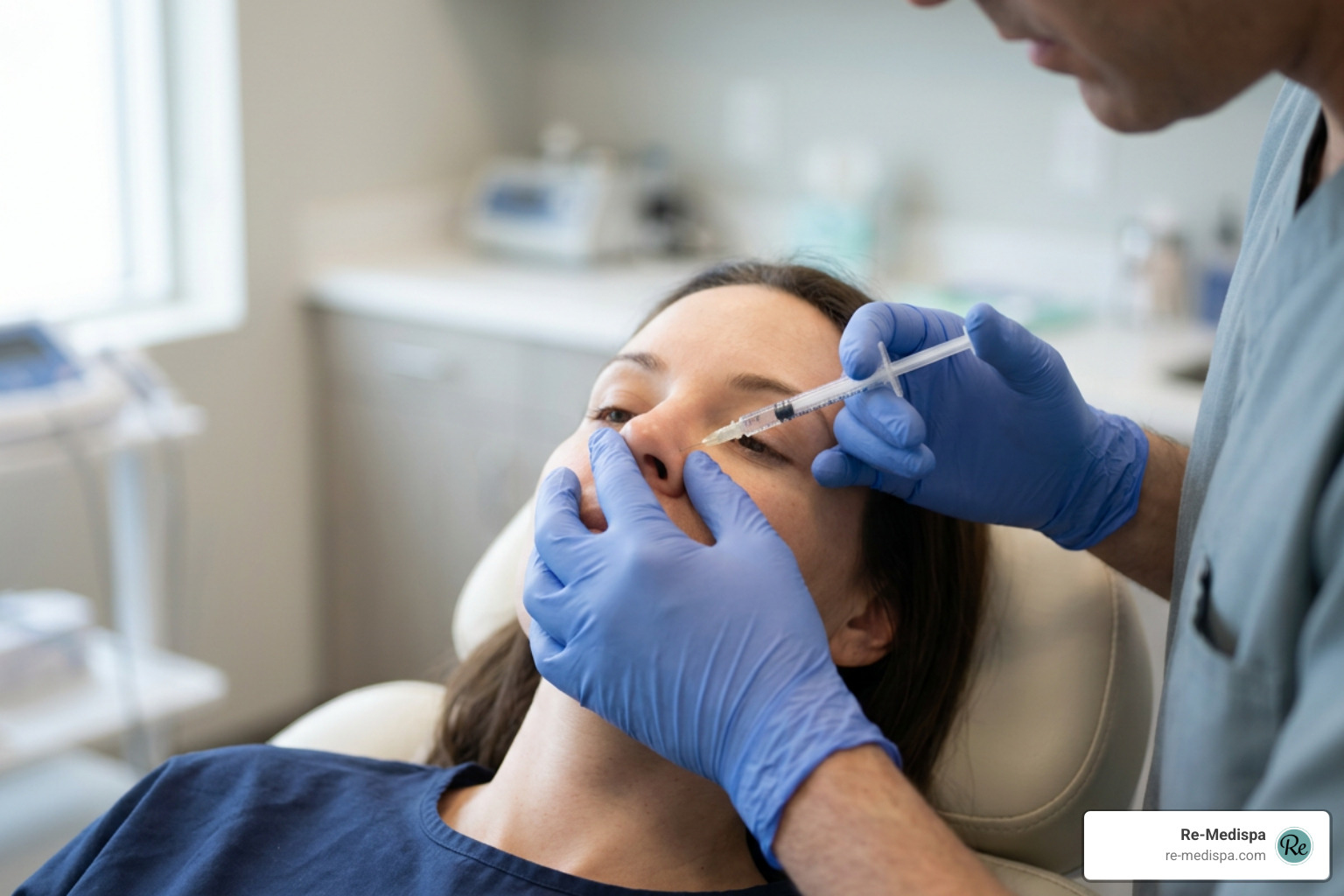
Over many years, excessive dosing can also lead to muscle atrophy, causing the forehead muscles to look too flat and the skin to appear thin. When one muscle group is completely frozen, your face may naturally recruit surrounding muscles to make expressions. This “muscle recruitment” can lead to new, unexpected wrinkles, such as “bunny lines” on the sides of your nose.
To review the complete safety profile, indications, and clinical trial data, you can consult the official HIGHLIGHTS OF PRESCRIBING INFORMATION.
Frequently Asked Questions About Forehead Wrinkle Prevention
How often should preventative treatments be administered?
Because preventative treatments use lower doses, the effects may wear off slightly faster than standard corrective doses. Most clients find that scheduling a touch-up every 3 to 4 months is ideal for maintaining consistent muscle relaxation. To maximize your results between appointments, read our expert tips on How to Make Your Botox Results Last Longer.
What happens if you stop getting preventative injections?
If you decide to stop your treatments, your muscles will gradually regain their full strength. Your face will simply go back to its natural aging process, and your expressions will return to how they were before. Botox will not stretch your skin or make your wrinkles worse if you stop.
Are there non-injection alternatives to prevent forehead lines?
Yes, injectables should always be paired with a healthy skincare routine. Daily broad-spectrum sunscreen is your first line of defense against collagen loss, while topical retinoids help speed up cell turnover. In-office treatments like chemical peels and microneedling are also excellent for supporting natural collagen production and improving skin texture.
The Re-Medispa Approach to Natural-Looking Prevention
At Re-Medispa, we believe that the best cosmetic work is invisible. Under the expert guidance of Renata Ciszek, Founder & Medical Director, we focus on delivering personalized, honest care that enhances your natural beauty rather than changing who you are.
We understand that taking the first step toward injectables can feel intimidating. That is why we utilize an advanced AI preview tool during your consultation. This technology allows you to visualize your potential results in real-time, helping us design a conservative treatment plan that aligns perfectly with your goals.
Whether you visit us at our Arlington Heights office (37 S Evergreen Ave) or our Harwood Heights location (5128 N Harlem Ave), you will receive the highest standard of clinical care. We proudly serve clients from across the Chicaland area, including nearby suburbs like Park Ridge, Mount Prospect, Palatine, and Glenview.
If you are ready to explore how botox for forehead prevention can help you maintain your youthful glow, we invite you to take the next step. Learn More info about injectables and schedule your personalized consultation with us today.